
B.Sc. in Medical Laboratory Sciences
Program Profile
Medical laboratory science (MLS) is a branch of medical science. Graduates will be able to analyze biochemical and biomedical tests of specimens and interpret results that assist in the diagnosis of disease. Furthermore, graduates will have the opportunity to work in a wide range of fields, including research, medical organizations, management, public health, and pursuing postgraduate study.
Occupational profiles of graduates
Give a brief description of the types of jobs for which the program prepares students and/or that graduates generally fulfil.
The graduated student can work in areas as diverse as:
- Academic researcher
- As a hospital laboratory professional
- Drug formulation and development
- Chemical or forensic analysis labs
- Product validation
- Quality control fields.
- Toxicology centers.
- Food analysis centers.
- Water sanitary stations and medical waste management centers.
Working in all kinds of diagnostic laboratories.
Qualification awarded
Bachelor of Medical Laboratory Sciences
Length of programme
4 Years
Number of credits
240 ECTS credits
Mode of Study
Full time ( 8hours/day), 5days/week
Read more about the programme
Get detailed information about the programme requirements, courses, credits, and educational objectives as a PDF file.
Program Educational Objectives (PEOs)
The Medical Laboratory Sciences program aims to graduate competent laboratory professionals who are capable of delivering safe, accurate, and ethical diagnostic services in healthcare settings.
The program prepares graduates to apply theoretical knowledge and practical skills across major laboratory disciplines, maintain high standards of biosafety and quality control, work effectively within multidisciplinary healthcare teams, engage in lifelong learning, and adapt to advances in laboratory technologies and research
Program Learning Outcomes
PLO1: Ability to use the basic principles of medical science, such as physiology, biochemistry, immunology, molecular biology and genetics, microbiology, toxicology, and pharmacology.
PLO2: An ability to evaluate clinical laboratory data, including biological fluid analysis, interpretation of laboratory results, and the combination of data to diagnose various disease conditions.
PLO3: An ability to apply basic laboratory techniques to various disease states.
PLO4: An ability to utilize knowledge and skills in their discipline in professional organizations.
PLO5: An ability to apply communication skills with patients of different ethnicities and cultures.
PLO6: Apply the skills required for testing laboratory equipment, assessing quality assurance for laboratory equipment, and working safely in the laboratory environment
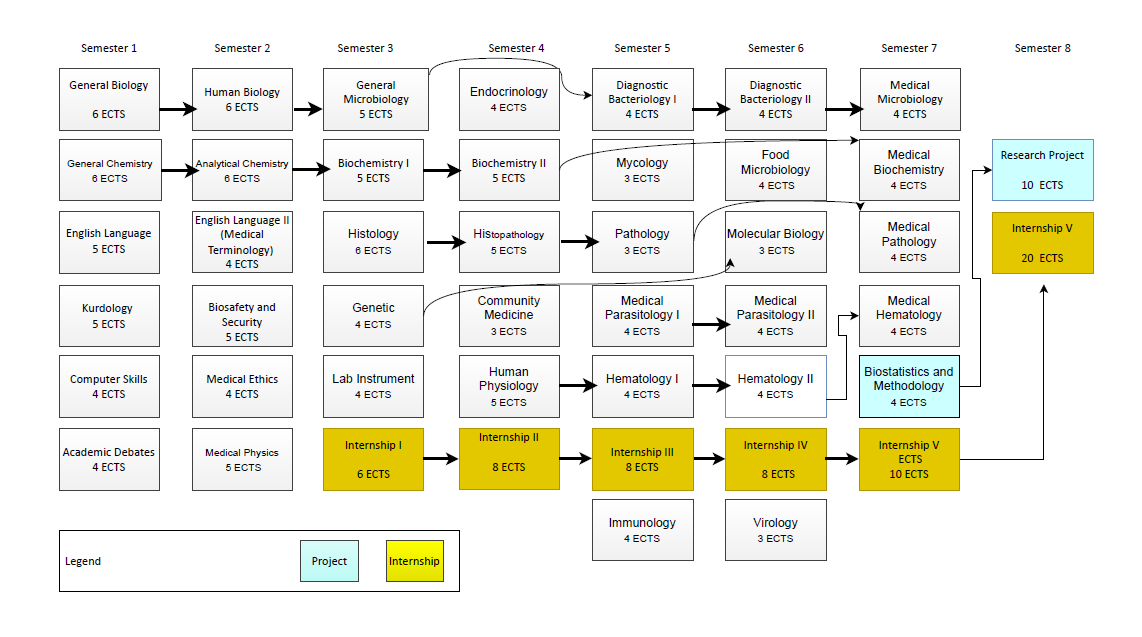
Programme structure diagram with credits
Yearly Timeline
Sept. 1, 2026
⚠️ First year students start around mid-October
⚠️ First year students start exams around 20 of January
July 1, 2027
Check out the full academic calendar on UoD's webstie.
Programme Coordinator

Molecular Parasitologist
Medical Laboratory Sciences
College of Health Sciences
University of Duhok
Apply to the Programme
Public undergraduate admissions in the KRG region are managed centrally by the Ministry of Higher Education through the online ZankoLine portal (regayzanko.com). After Grade 12 Baccalaureate results are released, high schools provide students with unique login credentials to rank their preferred universities and B.Sc. majors during a 10–14 day registration window. Final placement is automatically determined by the student's Grade 12 average, subject choices, and department capacity.